


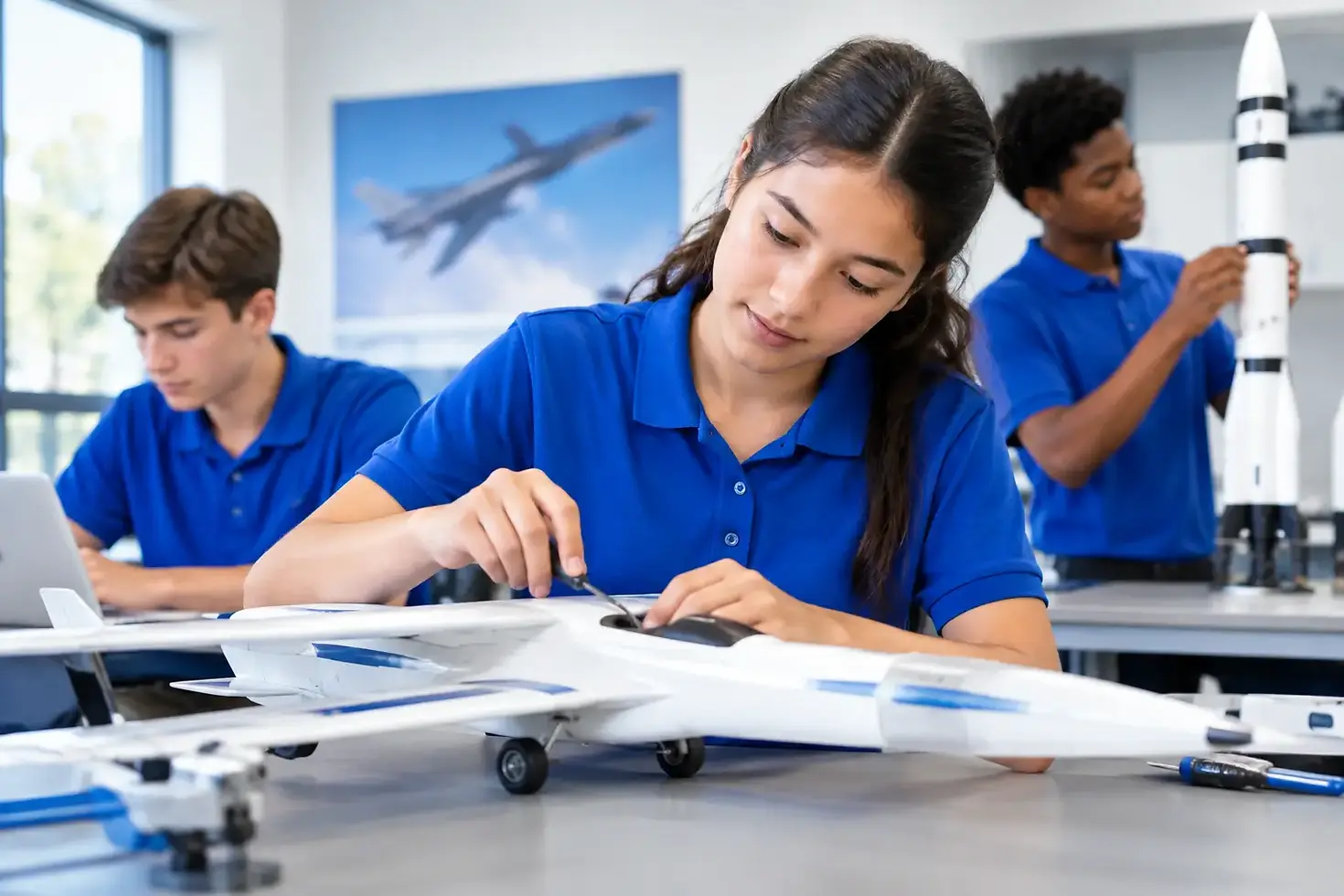
Ways to Build Aerospace Skills at School

A student staring at a rocket launch on a screen may be impressed. A student calculating a flight path, testing a glider, revising a design after failure, and explaining the results has started to think like an aerospace professional. That is the difference when students build aerospace skills at school: aerospace becomes more than an exciting subject. It becomes a practical way to strengthen confidence, academic skills, and future options.
For families in Melbourne, Florida, aerospace learning is especially meaningful. The Space Coast offers daily reminders that science, engineering, and innovation create real opportunities. But meaningful preparation does not begin with advanced rocket science in high school. It begins when children are given structured chances to ask questions, make things, test ideas, read carefully, and keep improving.
Aerospace Skills Start With Strong Foundations
Aerospace education is often associated with aircraft, satellites, space exploration, and launch vehicles. Those topics are motivating, but the most valuable skills are broader. Students need a command of mathematics, scientific reasoning, communication, technology, and collaboration. They also need the persistence to respond productively when a first design does not work.
In elementary grades, that foundation can look wonderfully simple. Students might observe how paper airplane wing shapes affect distance, use measurements to compare results, or read about the people behind historic aviation achievements. These activities develop vocabulary, number sense, observation, and curiosity without asking children to perform beyond their developmental level.
As students mature, the questions become more complex. Why does drag matter? How do sensors collect data? What material best balances strength and weight? How can code guide a device through a set of instructions? Each question connects classroom concepts to a challenge with a visible purpose.
The goal is not to turn every child into an aerospace engineer. Some students may discover an interest in design, coding, art, business, technical writing, environmental science, or another field entirely. Aerospace projects are valuable because they show students how different strengths contribute to ambitious work.
How Schools Build Aerospace Skills Through Projects
Hands-on projects give aerospace learning its power. Instead of memorizing terms in isolation, students apply concepts, make decisions, and see the consequences of those decisions. A prototype that veers off course or fails to carry its payload is not simply wrong. It is useful evidence.
A strong project-based approach follows a clear process: identify a challenge, research what is already known, develop a plan, build or model a solution, test it, analyze the results, and revise. This process teaches students that excellence is rarely achieved in one attempt. It is built through disciplined improvement.
For younger students, a challenge might involve designing a parachute that keeps a small object suspended in the air longer. Older students may work with forces, coding logic, flight simulation, robotics, or data collected from an experiment. The complexity should increase with the student, not be rushed because the topic sounds advanced.
Aerospace projects also make room for creativity. Engineering is not only calculation. Students may sketch prototypes, create visual presentations, develop a mission patch, or communicate a solution to an audience. Integrating the arts helps children recognize that innovation requires both technical accuracy and clear, compelling ideas.
The Value of Productive Failure
Parents understandably want their children to succeed. Yet an environment where every project works perfectly on the first try can limit growth. Aerospace learning gives students a safe, structured way to experience setbacks and move forward.
When a model does not perform as expected, educators can guide students to ask better questions. Was the measurement accurate? Did the team change more than one variable at a time? Does the data support the original prediction? This response turns frustration into analysis.
That mindset matters far beyond aerospace. Students who learn to revise their work develop resilience for challenging math problems, essays, college coursework, and future careers. They begin to understand that effort has direction when it is paired with reflection.
The Academic Skills Behind Every Flight
Aerospace education should never be treated as an extracurricular add-on that competes with academic growth. When thoughtfully designed, it strengthens the subjects students need most.
Mathematics supports measurement, scale, geometry, graphing, and data analysis. Science builds understanding of motion, energy, weather, materials, and systems. Reading helps students interpret technical information, research discoveries, and follow detailed procedures. Writing prepares them to document findings and defend their design choices.
Technology and engineering bring those disciplines together. Students may use digital tools to model an idea, organize data, create a presentation, or program a sequence of actions. Just as important, they learn responsible habits: checking information, using tools purposefully, and communicating respectfully with a team.
This is where a STREAM approach is especially effective. Science, Technology, Reading, Engineering, Arts, and Mathematics are not separate boxes in the school day. They become connected tools students use to solve a problem that matters.
Personalized Support Makes Ambitious Learning Possible
A challenging aerospace curriculum should be accessible, not exclusive. Students enter the classroom with different academic strengths, learning profiles, communication styles, and confidence levels. The right school environment recognizes those differences while maintaining meaningful expectations.
Small classes allow teachers to notice who needs an extra explanation, a different way to demonstrate understanding, more time to organize a task, or a greater challenge. Accommodations and assistive technology can help students participate more independently in research, writing, design, and collaboration.
Personalization does not mean lowering the bar. It means giving students a viable path to reach it. A child who needs support with reading can still contribute insightfully to a design team. A student who excels in math may be ready to take on more advanced calculations. Both should feel that their contributions matter.
At LFEC STREAM Academy, small class sizes and individualized instruction create space for this kind of student-centered growth. Students can pursue demanding, real-world learning while receiving the academic and developmental support needed to make progress with confidence.
What Parents Should Look For in Aerospace Learning
Not every activity labeled STEM or aerospace provides the same educational value. A one-time demonstration can inspire interest, but sustained skill development requires intentional instruction and regular opportunities to apply learning.
When evaluating a school, families should consider whether aerospace experiences are connected to the curriculum or offered only occasionally. Ask how students use math, reading, writing, and technology within projects. Find out whether students have opportunities to test, revise, present, and collaborate rather than simply follow a set of directions.
It is also worth asking how the school supports students with different learning needs. The strongest programs combine high expectations with responsive teaching. They give advanced learners room to stretch while ensuring that students who need accommodations can fully engage in the work.
Finally, look for evidence of progression. A kindergartner does not need the same tools or challenges as a tenth grader, but each student should be building toward greater independence, technical understanding, and problem-solving ability over time.
Future Readiness Is Bigger Than One Career
The aerospace sector offers exciting possibilities, from aviation and engineering to robotics, cybersecurity, advanced manufacturing, and space research. Still, the lasting benefit of aerospace education is not a promise that every student will choose a space-related career.
The greater promise is preparation. Students learn how to approach unfamiliar problems, work with others, communicate evidence, and keep going when the solution is not obvious. Those capabilities are valuable in college, the workplace, and daily life.
A school experience should help children see themselves as capable contributors to a changing world. When students are trusted with meaningful challenges and supported as they grow, they do more than imagine a future in innovation. They gain the skills and confidence to help shape it.


Comments